Engaging AI: Rethinking My Engagement Letter as a Solo Practitioner
Before launching Clark Smith Legal and taking this photo with my kids and a sea lion, I designed my engagement letter template – first, for existing clients; second, for new clients. My current template includes a two-sentence disclaimer about the possible use of artificial intelligence (aka “AI”) in the course of my legal representation. Since then, I’ve only tinkered around the edges with the template, while frequently employing AI in my work.
But last month’s Heppner ruling out of the Southern District of New York got me rethinking my AI disclaimer. Heppner held that strategy documents drafted by a defendant (not his attorney) with AI assistance were neither privileged nor confidential. After a grand jury indicted him, Defendant Heppner took his own initiative and prepared a case defense plan with input from Claude. The prosecution sought production of Heppner’s AI output. The judge held that Heppner’s actions were not made at his counsel’s instruction, did not otherwise constitute privileged communications and ordered their release
The opinion is worth reading. Attorneys presumably understand that AI tools can bring real legal consequences, but have we thought through how to communicate those consequences to clients? I certainly have not. That’s an engagement letter problem that most solo practitioners probably haven’t addressed.
How My Engagement Letters Addresses AI
My engagement letter includes only a throwaway reference to AI that likely aligns with the EL language used by many solos:
“I may employ artificial intelligence (AI) tools to assist in various legal tasks. Please be assured that any use of AI will be conducted in strict adherence to all ethical obligations, including confidentiality and diligence.”
It’s better than nothing. The client is put on notice that I may involve AI in carrying out my legal representation and it gestures toward my professional responsibilities in doing so. But it doesn’t actually tell the client anything. It’s a promise to be careful, not a description of what being careful means.
The AI Disclosure Dilemma
Let’s consider the nature of the engagement letter. It serves a dual purpose. The letter protects the lawyer by communicating to the client the lawyer’s expectations regarding scope, fees, and goals. But it also protects the client by securing informed consent – the client’s right to know what she’s getting into by laying out the material terms of the engagement.
AI usage is now a material term for most solo practitioners.
That’s not a controversial position. Most clients in 2026 would be more surprised to hear their attorney was not using AI than to learn that they were. Established firms understand this and have implemented practices that address disclosure obligations to meet client expectations.
Does that client expectation apply to a scrappy solo without big firm resources? I have assumed that to be the case. Since launch, I have used the same disclosure statement in 12 new client engagements without issue. That’s a small sample size. But so far, clients are either fine with the statement, haven’t noticed it, or don’t care.
Maybe the answer hinges on what AI tools are being used, and for what purpose. I’m drafting this post with AI help. Does that detail need to be disclosed in an EL? Of course not. On the other hand, I used Claude to build an automated invoicing system. The invoice is a key term of the engagement, each includes descriptions of legal services I’ve provided, and now an AI-based tool will be drafting mine. Should that detail be disclosed in the EL?
Very little bar or ethics guidance has trickled out on the narrow topic of AI disclosure in engagement letters. In a 2024 opinion (No. 512), the ABA referenced the topic:
“To obtain informed consent when using a GAI tool, merely adding general, boiler-plate provisions to engagement letters purporting to authorize the lawyer to use GAI is not sufficient.”
Thanks, ABA, for the boilerplate statement admonishing boilerplate statements.
West Virginia’s 2024 ethics opinion takes a more circumspect approach. The opinion doesn’t directly address what language to use in an engagement letter. But they came out strongly in favor of consulting directly with a client prior to using AI. “In certain circumstances, a lawyer’s decision NOT to use AI also may need to be communicated to the client particularly if using AI would benefit the client.”
The State Bar of Texas offers AI-disclosure language for engagement letters:
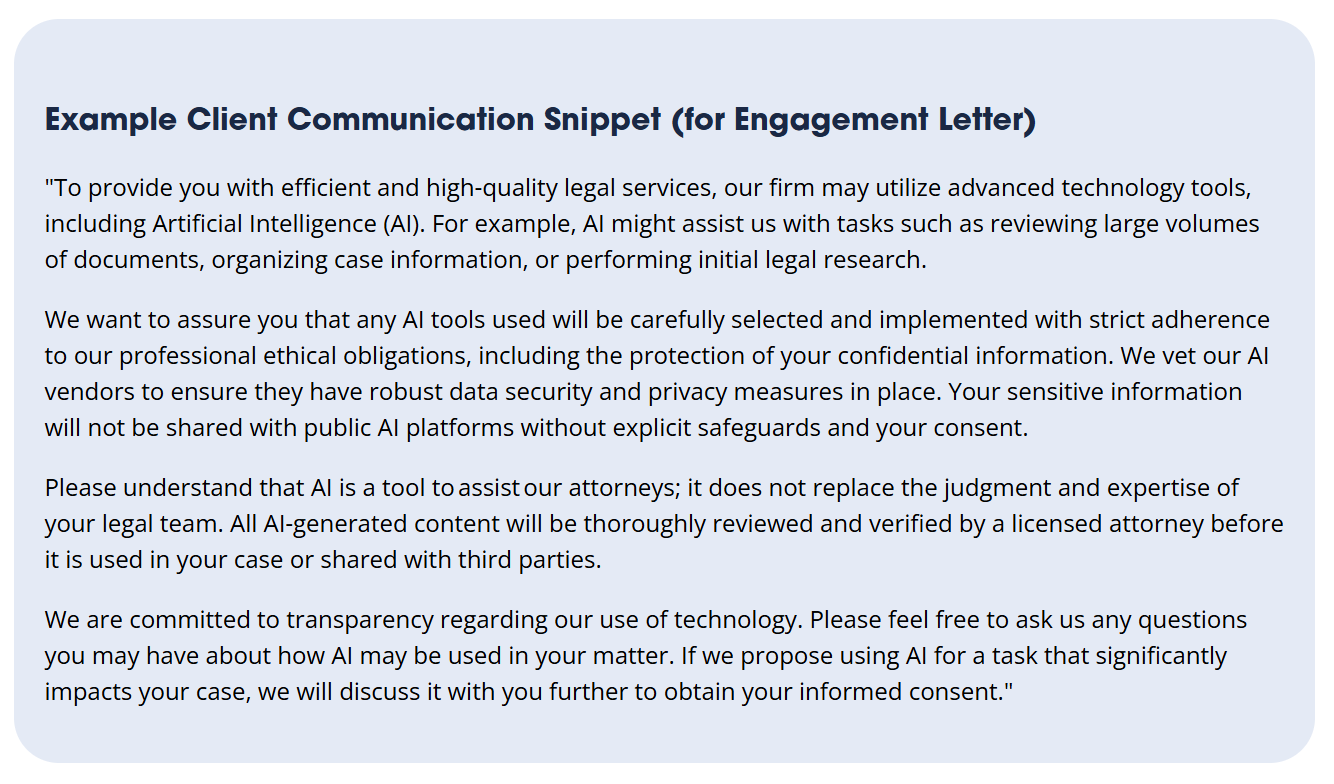
This example is well reasoned but geared towards multi-attorney litigation firms – not niche solos like me.
Back to Heppner. The case caught my attention, in part, because Heppner’s counsel could have avoided the ruling by disclosing to Heppner that use of AI brings litigation risks. Heppner either thought that the strategy documents wouldn’t be subject to discovery or – more likely – didn’t consider the implications of using AI at all. In hindsight, had counsel instructed Heppner to avoid any use of AI, the issue would have been avoided. For me, the ruling asks whether counsel had an obligation to tell Heppner not to use AI. And that’s led me to rethink my AI disclosure obligations. I’ll continue working on it but appreciate any thoughts you my cherished readers might have.